
One Year On
February 18, 2024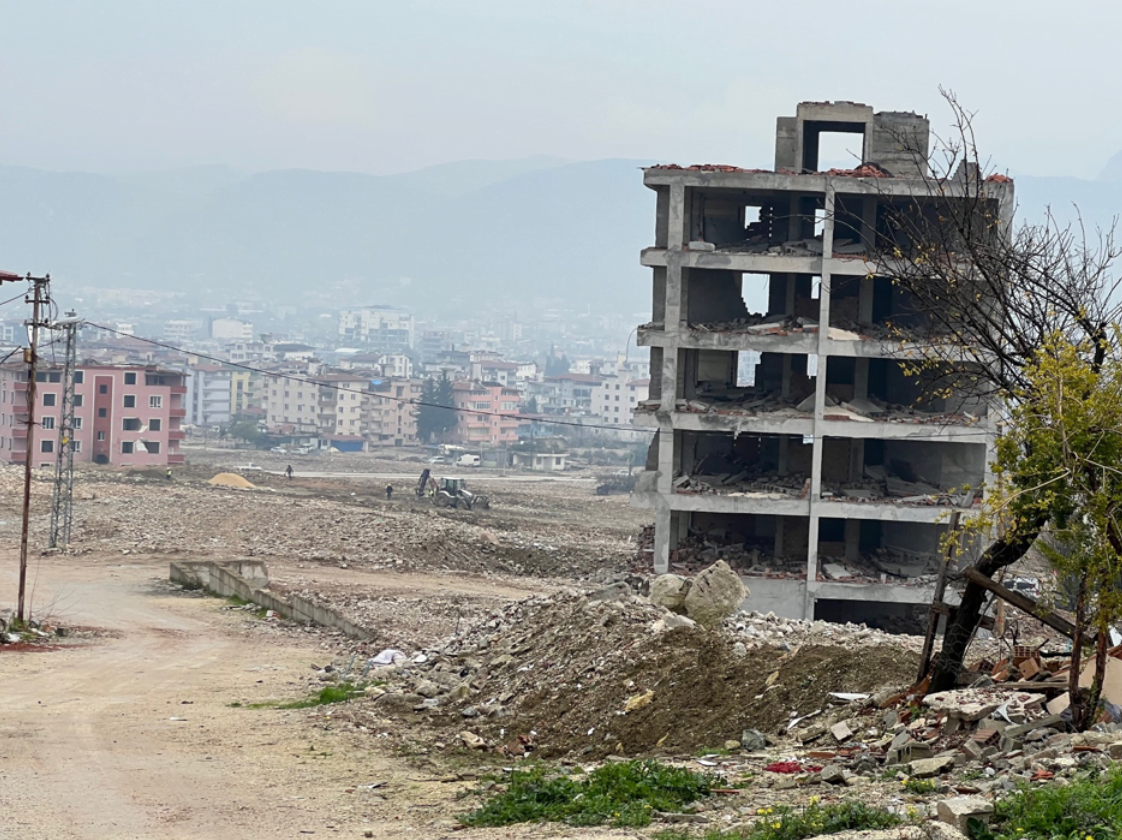
It is seven months since I last visited Antakya, so much of the city has been demolished. Empty spaces dominate, buildings await demolition. The outskirts of the city are occupied by refugee camps. Traffic is dominated by large trucks, the sides of the roads with petrol stations. The remaining population contend with living amongst the dust and noise of on-going demolition. Displaced communities, inflated food prices and the scarcity of shops are some of the day to day challenges for families.
There are very few safe spaces for children to play and as yet no playgrounds in the camps. Aftershocks are ongoing and trigger painful memories in the whole community.
I felt rather overwhelmed, witnessing how hard day-to-day life is and how disorientating it is to be living amongst demolition. You can’t let yourself think what lies amongst the rubble that people are picking over and which is all too often the playground for children.
The camps are overcrowded, and scabies is rife. Many families are forced to live amongst the safer buildings within the city whilst the city around them is demolished. There are tracks formed by trucks, very few shops and only limited numbers of schools are open. Day-to-day living is unimaginably hard. Organising activities for children in safe spaces is extremely challenging.
We have relocated our centre to the outskirts of the city as the area where we were operating is unsafe, water and electricity services are cut off for days at a time. Demolition work won’t start in that area until next year. The area is dangerous.
This is our new centre.

We are fortunate to be renting the ground floor of this building (inspected for safety by structural engineers) at least until January 2025.
It is from this building that we coordinate all our activities in Turkey and in northern Syria. Our teaching is increasingly online due to the situation. We have resumed our online pre-school literacy programme and 62 children are registered in this. This is a welcome return to the teaching we were doing before the earthquake. Our work in the camps is focused on applied science.
We are developing a progressive activities-based programme, for the next 12 months our target is to deliver high quality education for boys and girls aged 8-14 years.
We are reaching 990 children inside Syria and are training and mentoring 15 new teachers. We have 1,787 children attending one session a week in activities based science: the emphasis is on healing, group work and learning through play.
We are planning to introduce a more academic applied science course over the next few weeks – a stepped programme with specific academic goals. Children and staff are ready to embrace this and a year on from the devastation of the earthquake are ready for these new challenges.
I feel deeply humbled by what our staff are achieving for Syrian children affected firstly by war and more recently by the earthquake. I thank them wholeheartedly and thank you for your continued generous support.
M.C Project Coordinator February 2024